
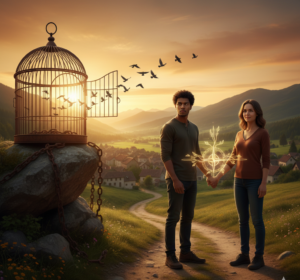
Freedom is a universal longing, an instinct that stirs within every human being, across all cultures and times. It is not merely political or physical liberation, but the inner ability to live in alignment with one’s values, to think one’s own thoughts, and to act with self agency. As a psychiatrist, I have come to see that human suffering often begins where freedom and meaning end.
Humans are not designed to be served, we are wired to serve. Service, whether to family, community, faith, or a larger cause, gives structure and purpose to freedom. Freedom without direction can lead to aimlessness, while service without freedom becomes oppression. The richest sense of meaning comes when the two are in balance, when one’s freedom is used in service of others, and one’s service expresses personal freedom.
Throughout history, civilizations that have stripped people of freedom, through tyranny, enslavement, or suppression of expression, have decayed from within. From ancient empires to modern regimes, when individuality is silenced, creativity and innovation vanish. Yet even through the greatest expression of lost freedom, slavery, people still found meaning. In the midst of unimaginable suffering, many discovered purpose in family, in faith, and in serving one another. In those acts of love, they reclaimed a deeper freedom, freedom of the spirit.
Conversely, history’s great builders of progress, whether in technology, art, music, or science, have found meaning by offering service to humanity. Many of the world’s wealthiest and most impactful individuals did not demand to be served, they created something that served others, a better tool, a song that healed, a story that inspired, or a discovery that changed lives.
I have seen this truth not only in history but in my own family. My brother and I left Trinidad three weeks apart in December 2005. I went to medical school, and he migrated to Canada. I watched silently as my mother mourned what she described as one of her biggest reasons for living. She often said how much she did for us and how proud she was of her role as a mother. Separately, she loved her job and took great pride in her work, and she also looked forward to retirement. Yet when that day finally came, she was met with another loss, the loss of daily purpose, of being needed. That quiet vacuum of meaning took a toll on her spirit, as it does for many.
As a psychiatrist, I see this pattern often. Parents find immense purpose in raising children, yet when those children grow up, they face an unexpected emptiness. Workers who spend decades looking forward to retirement often discover that freedom without service can feel hollow. In today’s world, where the void can be filled instantly with distractions, social media, games, and endless entertainment, many mistake stimulation for meaning. But the hole remains, and it quietly echoes the deeper question, what am I living for?
The beauty of my work is that I get to live thousands of lives in one lifetime. I listen to people search for meaning, yearn for freedom, and wrestle with what it means to truly live. I ask patients why not as interrogation, but as an invitation, an invitation to explore the meaning of their choices and to reflect the places in life where they have agency, that is, where they are free.
Losing freedom or meaning is not a curse, but it must first be acknowledged. Sometimes, the very pain of that loss becomes our teacher. That discomfort can be a guiding light, a motivator that pushes us to grow, to reclaim our agency, and to redefine what matters most. But it must be felt, not numbed. When we anesthetize pain with drugs, alcohol, food, sex, or the internet, we silence the signal meant to awaken us. The path back to meaning and freedom often begins with the courage to sit in discomfort and listen to what it is trying to say.
As a Christian, I believe that God gave humanity freedom as His greatest gift, born from love. The freedom to choose, to believe, to seek meaning, these are sacred expressions of that love. Even those who don’t believe or no longer believe in God do not deny the power of love. And love, at its highest form, is freedom, the willingness to let another be who they truly are.
Today, we give away our freedom far too easily. We surrender our thoughts to media and social media, allowing narratives of fear, envy, and division to define us. We live by external validation instead of internal conviction. True liberation comes when we reclaim ownership of our minds, our choices, and our purpose.
So I often return to the words of Bob Marley, whose wisdom transcends generations, “Emancipate yourselves from mental slavery, none but ourselves can free our Minds.” Freedom and service are not opposites, they are partners. When we live in service through the freedom of our own choosing, we find what all humans seek, meaning.
C Psychiatric Solutions
Delray Beach, Florida